Duct Sealing vs. Duct Replacement in Los Angeles: The Decision Starts With One Question You Probably Haven’t Been Asked
For most Los Angeles homes built after 1980, the rule of thumb holds: seal if leakage is under 30%, replace if it’s worse. But that formula was never written for a 1955 Koreatown duplex or a South LA bungalow with original cloth-wrapped duct runs. In those properties — and there are tens of thousands of them across the 90033–90036 ZIP corridors — the upstream question isn’t leakage percentage at all. It’s whether the existing ductwork insulation or mastic tape contains asbestos. That single factor can convert a $400 replacement job into a regulated abatement project with a materially different cost and a different class of contractor requirement. If you’re not sure where your property falls, call (866) 359-7544 for a no-pressure assessment before you commit to anything.
Why the Standard Comparison Breaks Down in Los Angeles’s Older Housing Stock
The advice you’ll read on most duct-comparison pages — “seal minor leaks, replace severely damaged ducts” — was essentially written for post-1980 tract homes in Sun Belt suburbs. It doesn’t account for what Matthew Gonzalez, Owner & Lead Technician at Elite Air Duct Cleaning Service Los Angeles, regularly finds when he opens an attic hatch on a pre-1960 property in South LA: original duct runs wrapped in cloth insulation with mastic sealing tape that predates the EPA’s 1978 asbestos ban.
In that situation, the leakage number becomes secondary. If the encapsulating material is intact, disturbing it — cutting out duct sections, pulling flex connections, repositioning runs — can release asbestos fibers into the air column the HVAC system will then circulate through every room. That isn’t a hypothetical. It’s a real protocol trigger, and it adds abatement costs and regulatory steps that the homeowner typically hasn’t budgeted for.
The practical implication: before any leakage test result or cost estimate is meaningful on a pre-1978 Los Angeles property, someone who has physically looked at the duct system needs to assess the insulation type and condition. A checklist filled out in a driveway doesn’t accomplish that.
When Aerosol Duct Sealing Is the Specifically Correct Answer — Not the Backup Plan
Aerosol duct sealing — the same class of technology used in Aeroseal-style systems — works from the inside of the duct. Pressurized sealant particles are introduced into the duct network, and as conditioned air tries to escape through gaps and joints, the particles accumulate at those leak points and bond. The exterior of the duct, including any encapsulating wrap on the outside, is never touched.
For a Koreatown apartment building where duct runs pass through shared walls or inaccessible floor chases, that inside-out approach isn’t a compromise — it’s often the only technically sound option. Full replacement in that type of construction means opening walls, navigating shared structural elements, and potentially disturbing exactly the encapsulated material you’re trying to leave alone. Sealing sidesteps all of that.
There’s a second LA-specific reason aerosol sealing earns its place here. Attic spaces across the LA basin routinely exceed 140°F on summer afternoons. That sustained heat degrades original mastic and cloth tape faster than in milder coastal climates — which is why leakage rates in these older homes tend to be high enough that the decision is genuinely consequential, not theoretical. When Matthew’s team runs a pressure test on a 1960s Silver Lake bungalow, a 25–35% leakage rate isn’t unusual. In many of those cases, aerosol sealing recovers most of that efficiency without requiring access to every duct run.
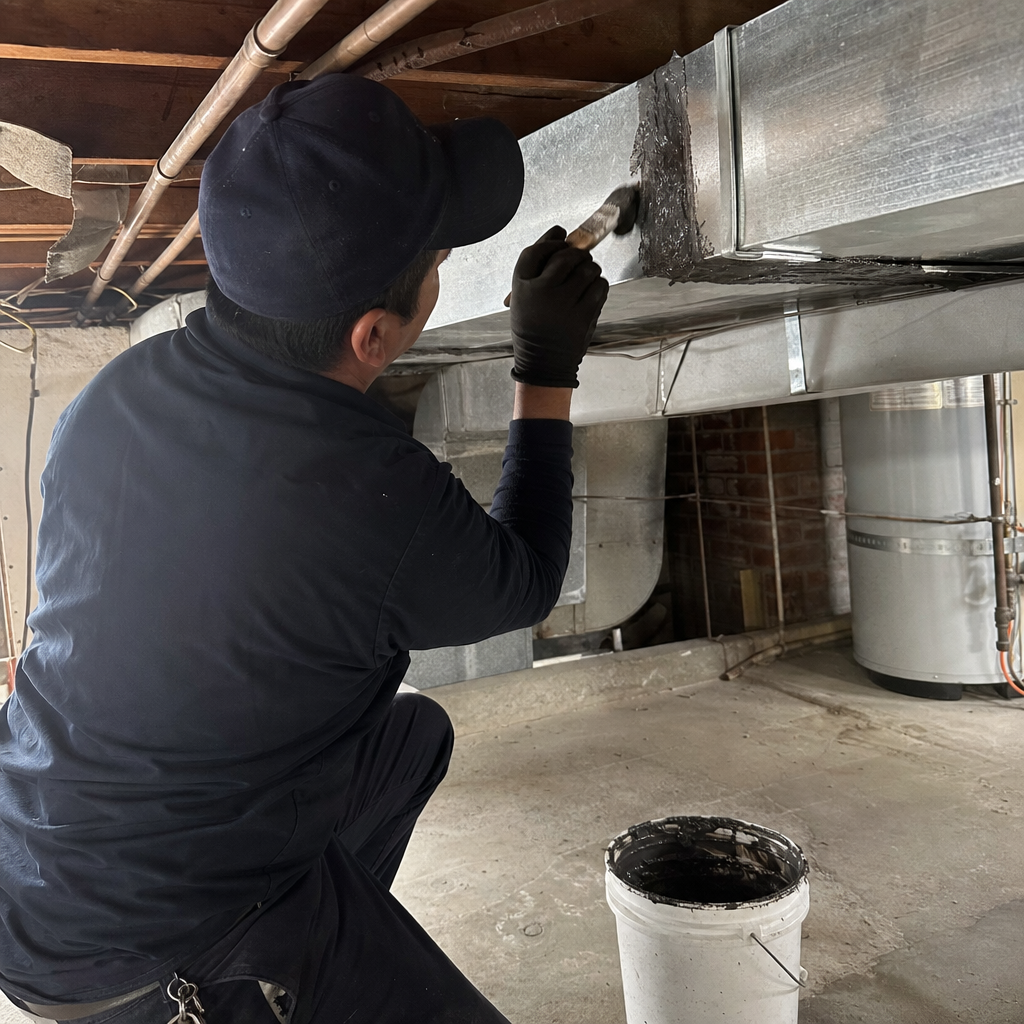
Our full Duct Repair & Sealing in Los Angeles service page covers the specific methods we use, but the short version is this: sealing and targeted repair handled by the same crew that inspected the system produces a cleaner result than coordinating a separate sealing contractor after a replacement crew has already been through.
The Honest Side-by-Side: Sealing vs. Replacement in Los Angeles Conditions
Here’s how the two options actually compare across the factors that matter most for Los Angeles’s housing stock:
| Factor | Duct Sealing | Full Duct Replacement |
|---|---|---|
| Pre-1978 asbestos risk | Interior process — exterior wrap undisturbed | Triggers abatement assessment; possible hazmat protocol |
| Multi-family / shared-wall buildings | Practical — no demolition of chases or walls | Often architecturally disruptive or structurally impractical |
| Leakage under ~25% | Strong candidate; sealing typically restores 80–90% of lost efficiency | Usually overkill; poor cost-benefit ratio |
| Leakage over 40% with structurally failing ducts | Sealing may not be sufficient if duct walls have collapsed sections | Replacement is warranted — if asbestos is ruled out first |
| Typical LA cost range | $500–$1,200 depending on system size and access | $1,800–$4,500+ for a single-family home; more for multi-family |
| Project timeline | Same day or next day in most cases | One to several days; longer if abatement is required |
The LA basin’s air quality reality adds one more variable worth naming. The 110, 10, and 101 freeways cut directly through the ZIP codes we serve most, and the basin geography traps exhaust, fine particulates, and wildfire smoke under a marine-inversion lid for days at a stretch. Every HVAC cycle pulls from that air column. If you’re replacing ducts, you want the new system sealed properly from the start — because a freshly installed duct run with leaky joints in an unconditioned attic will accumulate the same particulate load within a season.
How Matthew’s Team Approaches the Sealing-vs-Replacement Assessment
The sequence we follow on every job in a pre-1978 Los Angeles property:
- Visual inspection of the duct exterior. Matthew — not a subcontractor, not a crew member handed a checklist — physically enters the attic or crawl space and looks at the insulation wrap, tape condition, and duct material. If there’s any indication of pre-1978 construction with original insulation intact, that observation drives the next step before anything else moves forward.
- Pressure and leakage measurement. We quantify how much conditioned air is escaping the system before recommending anything. A pressure test on a 1960s property in the 90036 corridor routinely surfaces leakage rates that make a real efficiency and cost difference — this number frames whether sealing alone is sufficient or whether partial replacement of specific runs makes sense.
- Access and architectural assessment. In multi-family buildings where duct runs pass through shared chases or walls, we map out which sections can realistically be accessed and which can’t. This determines whether full replacement is even physically practical or whether sealing is the only reasonable path.
- Written recommendation with both options priced. If sealing and targeted repair will accomplish the efficiency goal without disturbing encapsulated materials, we say so clearly. If a section of ductwork is structurally failed and aerosol sealant can’t bridge it, we say that too — along with whether an abatement assessment is warranted before any replacement work begins.
- Service execution by the same crew that assessed. Matthew’s team handles the sealing or repair work directly, using professional-grade equipment including Rotobrush and Abatement Technologies systems. Clean ducts don’t announce themselves — you just breathe better and stop wondering why your filter fills up so fast.
That continuity — from inspection to recommendation to execution — is the part that matters most in situations where the wrong call has real consequences. Our Duct Repair & Sealing work is never handed off to a separate crew with no context about what was found during the assessment.
Frequently Asked Questions About Duct Sealing vs. Replacement in Los Angeles
Duct sealing in Los Angeles typically runs $500–$1,200 for a single-family home depending on system size, access difficulty, and leakage volume. Full duct replacement in the same market generally starts at $1,800–$2,500 and climbs to $4,500 or more for larger homes or systems requiring partial abatement assessment — the abatement step alone adds cost and lead time that most homeowners don’t anticipate when they get an initial replacement quote. Call (866) 359-7544 for an exact estimate on your specific property — assessments are free and carry no obligation.
If your property was built before 1978 and the original ductwork is still in place, an asbestos assessment is strongly advisable before any replacement or demolition of duct runs — particularly in South LA, Koreatown, and similar post-WWII neighborhoods where original cloth wrap and mastic tape are still commonly found. Aerosol sealing from the inside of the duct system avoids disturbing that exterior material entirely, which is one concrete reason it’s often the preferable first option in these properties.
Yes — aerosol-class duct sealing is effective at leakage rates in the 20–35% range and routinely recovers 80–90% of the efficiency being lost, which translates to measurable reductions in conditioned air waste. Replacement becomes the clearer call when structural sections of ductwork have physically collapsed, when the duct material itself has deteriorated past the point where sealing can bridge gaps, or when a full system redesign is needed for a renovation. Matthew’s team measures leakage before and after every sealing job so you see exactly what was recovered.
The honest answer is a pressure test — an actual measurement, not a visual guess. A technician who physically inspects the duct system and runs quantified leakage testing before recommending a solution is the baseline you should expect. We grew up working on Los Angeles housing stock across Boyle Heights, Silver Lake, and neighborhoods throughout the basin, and the recommendation Matthew makes is based on what he actually found in your attic — not a standard upsell script.
Ready to Find Out Which Option Actually Makes Sense for Your Property?
If your Los Angeles home or rental property is pre-1978 construction and you’re weighing duct sealing against replacement, the starting point is a direct assessment — not an estimate based on square footage alone. Elite Air Duct Cleaning Service Los Angeles offers a no-pressure evaluation with 387 verified reviews and 11 years of hands-on experience in this city’s specific housing stock. Call (866) 359-7544 to schedule your free estimate.
Written by Matthew Gonzalez, Owner & Lead Technician at Elite Air Duct Cleaning Service Los Angeles, serving Los Angeles, CA.