
Emergency Air Duct Cleaning Near Me: What Bell Homeowners Should Do First
When Bell homeowners search “emergency air duct cleaning near me,” the first 30 minutes after discovering contamination matters more than which contractor you eventually hire. Shut off your HVAC system immediately, document everything with photos, and keep household members away from vents — these three steps prevent a $200 cleaning from becoming a $4,000 remediation. If you’d rather not handle the assessment yourself, Elite Air Duct Cleaning Service Los Angeles responds to Bell emergencies with same-day availability — call (866) 359-7544.
Here’s the mistake we see most often: a Bell homeowner discovers droppings near a register, smells something foul from the vents, or spots mold around a duct opening — and their first instinct is to crank the fan to “clear the air.” That single decision can spread contaminants through every room in under ten minutes. After 11 years of emergency calls in Bell and surrounding neighborhoods, we’ve learned that what you do before we arrive often determines whether the job stays straightforward or escalates into something far more involved.
Why “Emergency” Means Something Different for Ducts
Not every dirty duct is an emergency. Dust buildup over years? That’s maintenance. But certain situations in Bell homes demand immediate action because the risk compounds with every minute the system runs.
True duct emergencies in our experience fall into three categories:
- Biological contamination: Rodent droppings, dead animals, or sewage backup introducing pathogens into the airflow
- Active mold growth: Visible mold at multiple registers, especially after water damage or the humid stretches Bell gets between July and October
- Chemical or smoke contamination: Fire damage, pesticide fogging, or construction debris that entered the return system
The common thread: airborne particles that your HVAC will distribute evenly through every room. In Bell’s older housing stock — particularly the postwar bungalows and duplexes common south of Florence Avenue — duct systems are often interconnected in ways that surprise homeowners. A problem in one branch doesn’t stay isolated.
We pulled a job last month in the Bell Manor neighborhood where a homeowner had noticed a musty smell from their bedroom vent. They’d been running the AC for three days before calling. By the time Matthew arrived to assess, the microbial contamination that started in one return had colonized the entire trunk line. What could have been a standard cleaning with Abatement Technologies HEPA extraction became a full sanitizing job with Guardsman antimicrobial treatment. The homeowner’s quick call after those three days still saved them from needing duct replacement — but their delay added roughly $800 to the final scope.
Your First 30 Minutes: A Step-by-Step Checklist
This is the section most “emergency duct cleaning” articles skip entirely. They jump straight to contractor selection. But in Bell’s climate — where summer humidity spikes can accelerate mold growth and older rooflines invite rodent access — your immediate actions shape everything that follows.
Step 1: Shut down completely. Turn off your HVAC system at the thermostat, then cut power at the breaker if you can locate it. Don’t just switch to “fan off” — the blower can still cycle. This stops the distribution network from pushing contaminants into living spaces.
Step 2: Seal the area. Close doors to rooms with affected vents. If you have plastic sheeting or even garbage bags, tape them over registers in contaminated zones. You’re not trying to fix anything — just limiting the footprint.
Step 3: Document before touching anything. Take dated photos of visible contamination at registers, around the furnace or air handler, and any access points. Shoot video with narration describing when you first noticed the problem and any recent events (water leak, pest activity, renovation work). This documentation protects potential insurance claims and gives contractors accurate information before they arrive.
Step 4: Protect occupants. Anyone with asthma, allergies, or compromised immunity should leave the house if possible. At minimum, they should avoid the affected rooms. In Bell’s dense housing, we often see multi-generational households where this step gets overlooked until someone’s symptoms flare.
Step 5: Don’t attempt DIY cleaning. Vacuuming a register surface or spraying household cleaner into a vent opening will not address interior contamination — and can force debris deeper into the system or aerosolize pathogens. Leave the duct interior alone.
Step 6: Call with specifics ready. See the next section for exactly what to say.
How to Assess Severity Yourself: Surface vs. System Contamination
Not every alarming sight requires emergency dispatch. Learning to distinguish surface-level issues from system-wide contamination can save you an after-hours fee — or confirm you need immediate response.
Surface-only indicators (can typically wait for standard scheduling):
- Dust accumulation visible only on the register face, wipeable with a damp cloth
- Single vent with minor discoloration, no corresponding smell from the airflow
- Recent construction dust settling on nearby surfaces, including vent covers
System-level warning signs (emergency response warranted):
- Odor that intensifies when the system runs, especially musty, ammonia, or decomposition smells
- Visible debris blowing from vents — insulation fragments, droppings, or organic matter
- Multiple registers showing similar contamination patterns
- Water stains or rust around duct connections, particularly in Bell’s older homes with original galvanized ductwork
- Recent rodent activity in attic or crawl space (common near the I-710 corridor where we’ve seen persistent roof rat pressure)
One practical test: hold a white paper towel against the vent with the system off for thirty seconds, then remove it. Light dust is normal. Dark staining, moisture, or particulate matter suggests interior issues requiring professional inspection with camera equipment.
What to Say When You Call for Emergency Service
The difference between a vague “something’s wrong with my ducts” and a specific report gets you accurate pricing and appropriate equipment dispatch — not a standard crew with a rush fee attached.
Here’s the information that lets a legitimate emergency contractor give you a meaningful estimate:
- System type and age: “Forced air, original ductwork from 1962” or “Updated system with flex duct, installed 2019”
- Contamination type: Be specific — “rodent droppings at three upstairs registers” not “dirty vents”
- Square footage and vent count: This determines equipment sizing and crew requirements
- Accessibility: Attic access, crawl space clearance, or any known restrictions
- Insurance involvement: Whether you’re filing a claim and need documentation
- Timeline: When you discovered the issue and what you’ve done since
A contractor who treats emergencies seriously will ask these questions. One who gives you a flat rate without detail is likely planning to assess on arrival and adjust upward — or worse, they’re equipped for standard cleaning, not remediation-grade work.
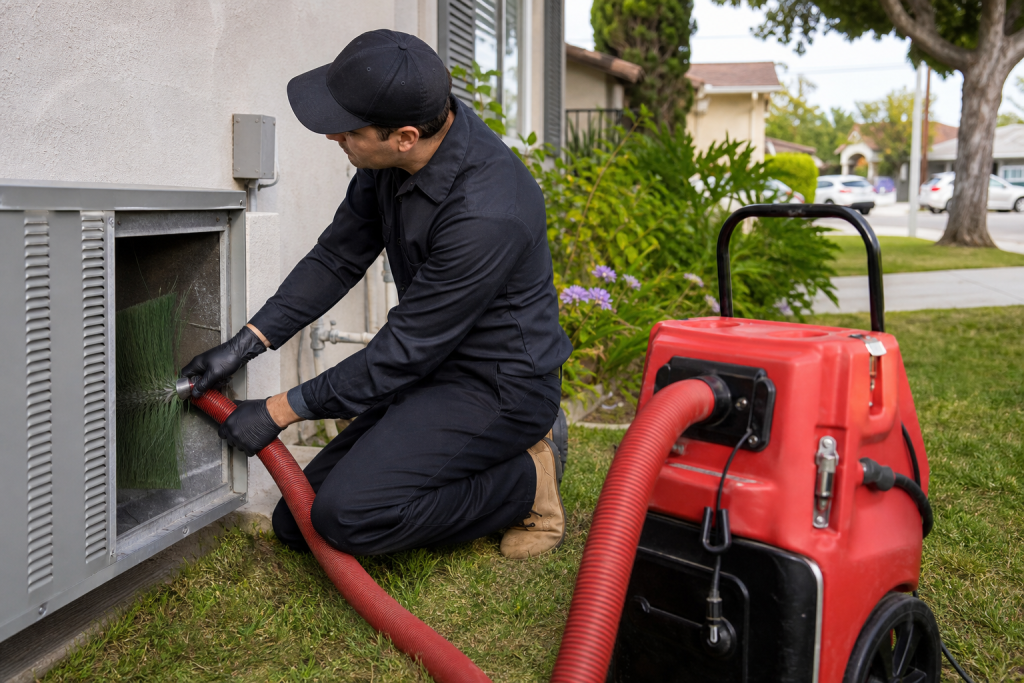
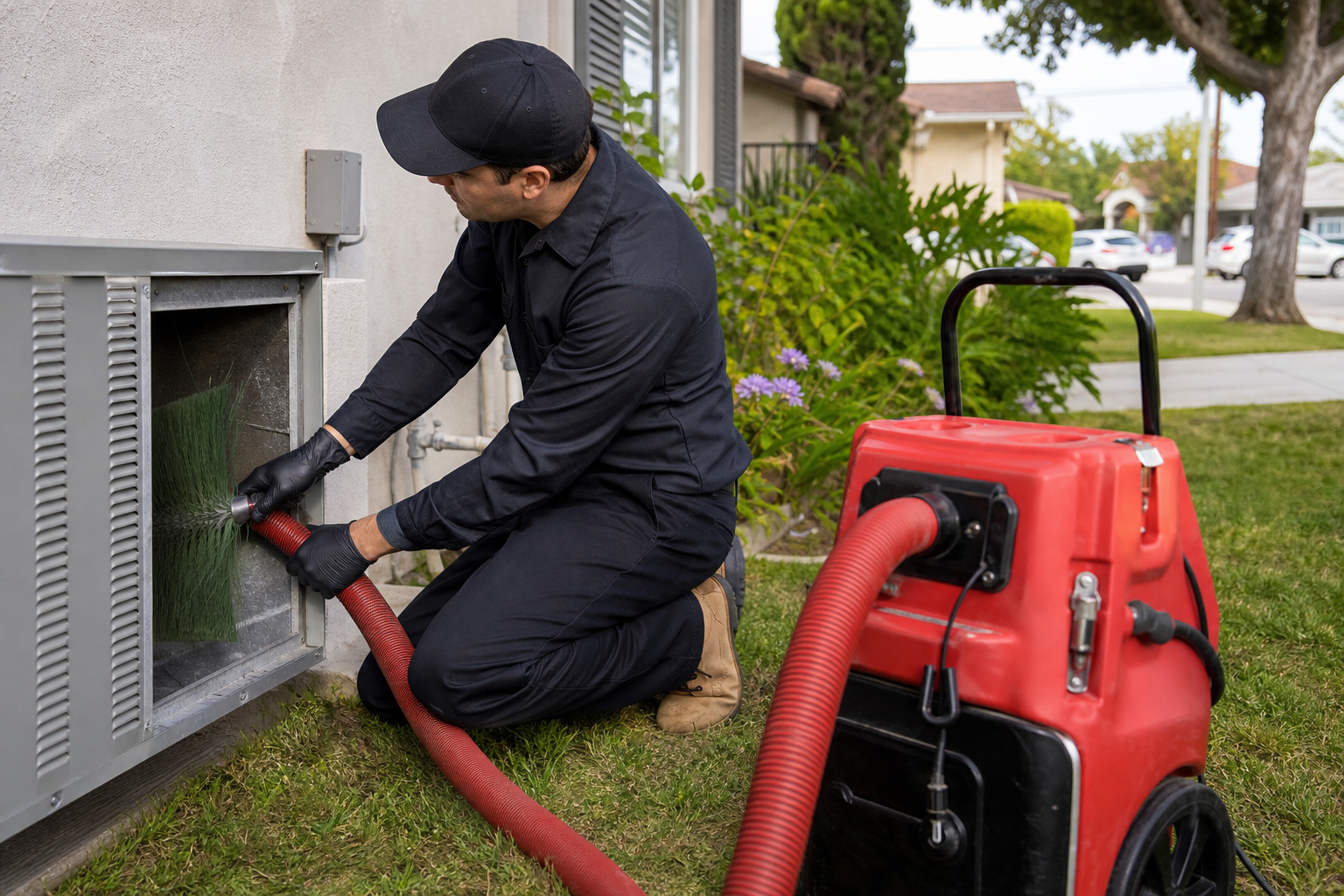
When you call Elite Air Duct Cleaning Service Los Angeles at (866) (359) 359-7544, Matthew Gonzalez or our dispatch will walk through this checklist. If the situation warrants, we bring Rotobrush and Nikro systems configured for biohazard extraction, not just routine maintenance. We’ve learned that arriving with wrong equipment costs everyone time — especially in Bell’s tighter construction where second trips are disruptive.
Emergency Equipment vs. Standard Cleaning: What Bell Homeowners Should Verify
Not every contractor who answers an emergency call is actually equipped for one. The distinction matters when you’re paying premium rates and need results, not just speed.
Standard duct cleaning equipment — portable vacuums and basic brush systems — handles routine dust and debris fine. But biological contamination, mold, or sewage requires negative air pressure containment, HEPA filtration rated at 99.97% at 0.3 microns, and antimicrobial application capability.
Questions to ask any emergency contractor:
- “What extraction system will you bring — HEPA-filtered negative air or standard vacuum?”
- “Do you carry antimicrobial treatments, and are they EPA-registered for HVAC systems?”
- “Will the technician inspect with a camera before and after?”
- “What’s your containment protocol for biohazard material?”
We specify Abatement Technologies portable HEPA units for emergency calls because they’re the same class used in commercial remediation — overkill for routine cleaning, essential when we’re extracting rodent debris or mold colonies. Honeywell and Aprilaire filtration upgrades come into play post-cleaning for households with ongoing air quality concerns.
The contractor who treats your emergency as “standard cleaning plus rush fee” will likely show up with a Rotobrush or similar — excellent equipment, but not configured for containment. Verify before you commit.
Insurance Documentation: Protect Your Claim Before Cleaning Begins
This is where Bell homeowners often lose recoverable costs. Once cleaning begins, evidence of pre-existing contamination gets destroyed — and adjusters may dispute whether the damage warranted the scope of work performed.
Before any contractor starts:
- Contact your insurance carrier to report the incident and request a claim number
- Request adjuster inspection before remediation if timeline allows — many carriers have 24-48 hour response for emergency situations
- Provide your contractor with the claim number and request detailed, photo-documented scope of work
- Obtain pre- and post-cleaning video inspection footage
- Keep all invoices itemized — cleaning, sanitizing, and repair as separate line items
Some Bell homeowners’ policies cover duct contamination resulting from covered perils (water damage from pipe burst, fire smoke, etc.) but exclude maintenance-related issues. Documentation determines which category applies.
We’ve worked with enough insurance adjusters over 11 years to provide the detailed reporting they expect — contamination type, extent, methodology, and verification. If you’re navigating a claim, mention this when you call; we’ll structure our documentation accordingly.
When to Call a Professional Immediately
If you’ve shut down your system, documented the situation, and any of the following apply, call for emergency service now:
- Multiple registers show contamination
- Anyone in the household is experiencing respiratory symptoms
- You’ve confirmed or strongly suspect rodent or sewage involvement
- The HVAC system has been running since discovery
- You need insurance documentation before remediation
In Bell’s housing market, where many families rent out portions of their property or operate home-based businesses, liability concerns add urgency. A tenant with documented health complaints linked to contaminated ducts creates exposure beyond the immediate repair cost.
Related services in Bell: Depending on what our inspection reveals, your situation may also require Dryer Vent Cleaning in Bell Gardens (if lint accumulation has compounded airflow issues), HVAC Cleaning in Bell Gardens (for coil and blower contamination), or Air Duct Cleaning in Bell Gardens (for our standard deep-cleaning protocol). We assess the full system — not just what you called about — because partial solutions leave problems recurring.
The Bottom Line
Emergency air duct situations in Bell reward preparation over panic. Shut the system, document everything, protect vulnerable household members, and call with specifics. The contractor you choose should match equipment to contamination type — not just arrive quickly with standard tools.
After 387 customer reviews averaging 4.9 stars across 11 years, our approach is straightforward: Matthew is on the job, we bring equipment appropriate to the actual problem, and we document thoroughly for insurance when needed. One crew handles cleaning, repair, sealing, and sanitizing — no coordinating multiple contractors while your system sits offline.
If you’re in Bell and facing a duct emergency — or you’re unsure whether your situation qualifies — call (866) 359-7544 for a free estimate. We’ll help you assess urgency accurately and respond with the right equipment, not just the fastest truck.
Frequently Asked Questions
Emergency duct cleaning in Bell typically ranges from $350 to $800 for standard residential systems, with biohazard or mold remediation starting around $900 depending on contamination extent and required sanitizing. True emergencies requiring after-hours dispatch or specialized containment add 20-40% to base rates. Call (866) 359-7544 for an exact quote — estimates are free, and we’ll help you determine whether your situation actually requires emergency pricing or can schedule standard service.
Yes — Elite Air Duct Cleaning Service Los Angeles maintains same-day emergency availability for Bell and surrounding areas when contamination poses immediate health or system risks. Response time depends on current schedule and equipment configuration needed; biological contamination calls get priority dispatch with HEPA-contained extraction units. Call (866) 359-7544 with your specifics and we’ll confirm arrival window.
Cleaning and sealing existing ductwork is almost always more cost-effective than replacement for Bell’s typical residential systems — replacement runs $3,000-$7,000 versus $350-$1,200 for professional cleaning with sanitizing. We only recommend replacement when ducts are structurally compromised (collapsed sections, extensive rust-through, or asbestos-containing materials in pre-1980 homes). Our camera inspection determines which path makes sense for your specific situation.
Ask specifically about their extraction system — they should name HEPA-filtered negative air equipment or equivalent, not just “powerful vacuums.” Request whether they carry EPA-registered antimicrobial treatments and perform pre/post camera inspection. A contractor who can’t describe their containment protocol or equipment brands is likely treating your emergency as rushed standard service. At Elite, we specify Abatement Technologies, Rotobrush, and Nikro systems by job requirement — ask us and we’ll explain exactly what we’re bringing and why.
Written by Matthew Gonzalez, Owner & Lead Technician at Elite Air Duct Cleaning Service Los Angeles, serving Bell since 2015.
Need Air Duct Cleaning Help?
Call Elite Air Duct Cleaning Service Los Angeles — licensed & insured, here with fast after-hours help in Los Angeles.
(866) 359-7544