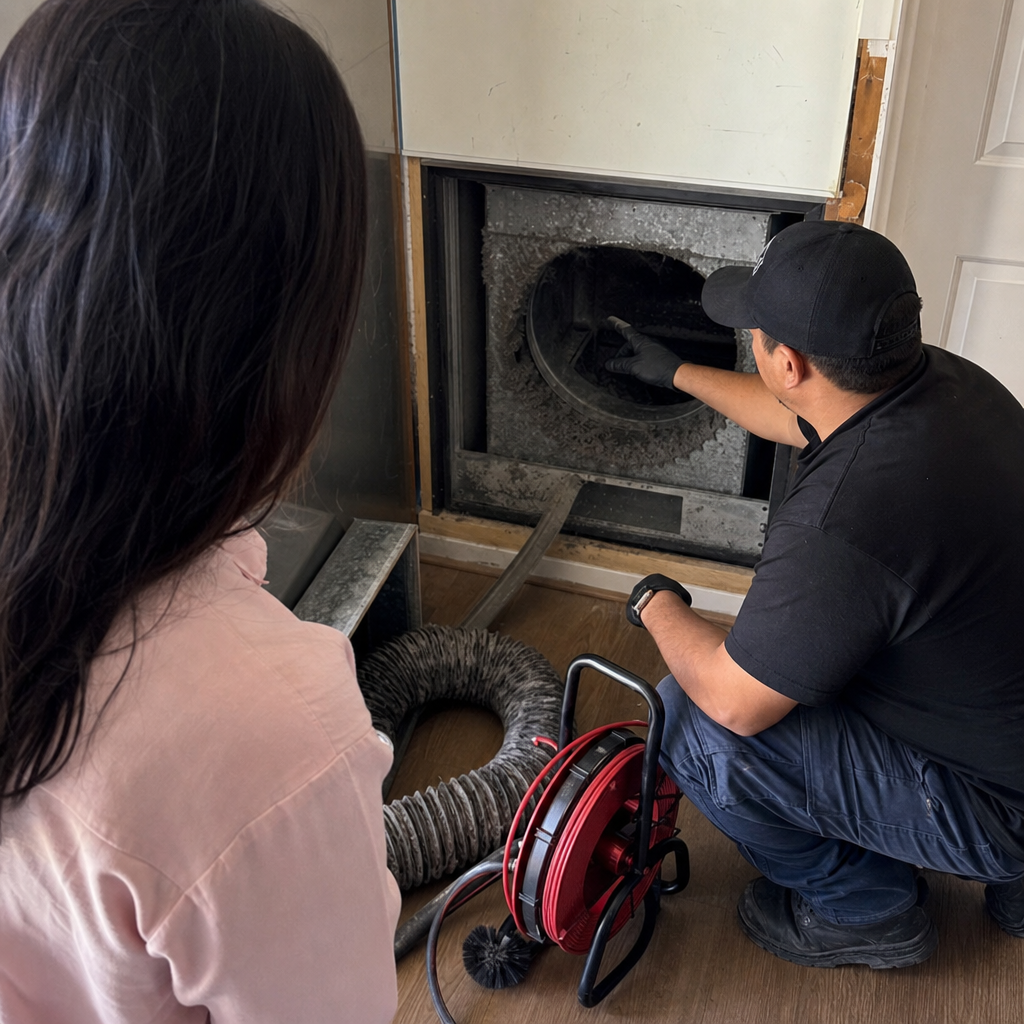
How Often Should Dryer Vents Be Cleaned in Los Angeles? Here’s the Honest Answer
Most dryer vents in Los Angeles should be cleaned at least once a year — but in the older multi-family buildings that dominate ZIP codes like 90006 and 90007, we see vents that need attention every six months because longer duct runs, shared exhaust stacks, and decades of deferred maintenance create lint buildup far faster than the standard calendar suggests. If your dryer is taking two cycles to finish a load, the exterior vent flap barely opens when the dryer runs, or the outside of the machine feels unusually hot to the touch, don’t wait for the annual mark. Call (866) 359-7544 — we’ll tell you honestly whether it needs cleaning or not.

Why Los Angeles Housing Changes the Calculus
The generic advice you’ll find online — “clean it once a year” — was written for a hypothetical house with a short, straight vent run exiting through a side wall. A lot of Los Angeles housing stock doesn’t work that way.
The post-WWII bungalows and Craftsman duplexes built through the 1940s and ’60s across South LA and Koreatown were designed before clothes dryers were common appliances. When dryers got retrofitted into these homes, vent runs got creative: long horizontal stretches through interior walls, sharp 90-degree turns through closets, and termination points that sometimes exit under a deck or into a crawl space rather than straight to open air. Every extra foot of run and every additional elbow reduces airflow and increases the surface area where lint can cling and compress.
Add to that the LA basin’s air quality profile. Santa Ana wind events — which typically run October through March — push fine Mojave Desert dust and, during fire season, ash from the Angeles and Santa Monica Mountains directly into HVAC return-air intakes and through loosely sealed older buildings. Matthew Gonzalez, our owner and lead technician, has pulled gray-brown ash deposits off supply registers in Koreatown apartments where the windows never opened during a fire event. That same particulate load coats dryer lint screens and duct interiors, compounding the restriction over time. In Los Angeles, “once a year” is a starting point, not a ceiling.
What to Actually Look For: Comparing Signs by Urgency
Rather than waiting for a calendar reminder, watch for the signals your dryer is already sending. Some are low-urgency maintenance flags; others mean you should stop running the dryer until it’s serviced.
Low-Urgency Signals — Schedule Within the Month
- Drying times have crept up 10–15 minutes longer than they used to be
- The lint trap fills noticeably faster than it did a year ago
- A mild musty smell near the dryer after a cycle
- The exterior vent flap opens sluggishly or only partway during operation
High-Urgency Signals — Stop the Dryer and Call Now
- Clothes are hot but still damp after a full cycle — the vent is significantly restricted
- The top of the dryer or the exhaust hose at the back is hot enough to be uncomfortable to touch
- A burning smell during or after a cycle — lint can ignite at temperatures well within normal dryer operating range
- Visible lint around the exterior vent cap or on the ground beneath it
- The laundry room feels humid or steamy when the dryer runs — moisture is backing up instead of exhausting
The distinction matters because a dryer vent clogged past a certain point isn’t just an inefficiency — it’s a fire hazard. Lint is highly flammable, and the combination of restricted airflow and sustained heat creates conditions where a fire can start inside the duct itself. We don’t say that to alarm you; we say it because it’s a straightforward physical reality that’s worth understanding.
How We Clean a Dryer Vent — Step by Step
- Inspect the full vent path. Before touching a brush, we trace the vent run from the dryer connection to the exterior termination point. In older Los Angeles homes, this sometimes reveals duct sections that were never properly connected or that have been partially crushed behind a wall — problems that affect airflow regardless of how well you clean.
- Disconnect and check the transition hose. The flexible hose connecting the dryer to the wall duct is the most common restriction point. We check it for kinks, tears, and lint accumulation before moving further.
- Run the rotary brush system through the full duct run. We use professional-grade equipment — including Rotobrush systems — designed to agitate and extract compacted lint rather than just push it toward the exit. Consumer-grade flexible rods can break up surface buildup; they don’t address the compressed deposits that form in elbows over years of use.
- Clear and test the exterior termination cap. Bird nests, lint accumulation, and damaged flap mechanisms at the cap are among the most common causes of chronic restriction in Los Angeles — especially in ground-floor units with low termination points near landscaping.
- Run the dryer and verify airflow. We confirm the job with a live test — the vent flap should open fully and exhaust should be clearly felt at the exterior cap. If it isn’t, we troubleshoot rather than pack up.
- Document and advise. If we find duct damage, improper materials (foil accordion hose in long runs, for example), or a termination point that needs correction, we tell you directly — and we can handle the repair in the same visit under our Dryer Vent Cleaning in Los Angeles service.
Dryer Vent Cleaning Pricing in Los Angeles
Pricing for dryer vent cleaning in Los Angeles generally falls in the ranges below. Factors that push toward the higher end include longer duct runs (common in older bungalows where the laundry was added as an afterthought), multiple elbows, second-floor or rooftop termination points, and vents that haven’t been serviced in several years and carry heavy compacted buildup.
| Service | Typical Range |
|---|---|
| Standard dryer vent cleaning (single-family, short run) | $89 – $149 |
| Extended run or multi-elbow configuration | $149 – $229 |
| Rooftop or high-rise termination | $199 – $299 |
| Dryer vent cleaning + reroute or repair | $249 – $450+ |
Estimates are free and firm before any work begins. We’ve been doing this in Los Angeles for 11 years — 387 customers have reviewed us and the average is 4.9 stars — because we don’t quote one number and invoice another.
“Clean ducts don’t announce themselves — you just breathe better and stop wondering why your filter fills up so fast.” The same principle applies to dryer vents: a clear, properly terminated vent path is quiet, efficient, and forgettable in the best possible way. You notice it only when it’s gone wrong.
For full-system coverage — Dryer Vent Cleaning, duct cleaning, HVAC cleaning, or air quality sanitizing — we operate as one crew handling every service, which means no coordinating multiple contractors and no gaps in accountability. That matters in a market like Los Angeles where the alphabet of HVAC subcontractors can leave a homeowner with no clear answer about who did what.
Frequently Asked Questions
In homes built before 1970 — which represent a large share of the housing stock in neighborhoods like Koreatown, South LA, and Mid-City — we recommend cleaning every six to twelve months rather than the standard annual interval. Retrofitted vent runs in these buildings tend to be longer, have more direction changes, and often use older flexible duct materials that accumulate lint faster than smooth rigid metal duct. If you’re unsure how long your run is or where it terminates, that’s the first question worth answering. Call (866) 359-7544 and we can assess it before you book.
You can clear the first few feet of a short, straight vent run with a consumer brush kit, and doing that between professional visits is genuinely useful maintenance. Where DIY falls short is in long runs, multi-elbow configurations, and vents that haven’t been serviced in years — the compacted lint in those sections requires rotary equipment like a Rotobrush system to fully dislodge. A brush kit pushed into a heavily loaded duct can also compact the restriction further rather than remove it. For anything beyond a simple accessible run, a professional visit is the right call.
The clearest real-time indicator is drying time — if a normal load takes more than 45 to 50 minutes on a medium heat setting, airflow restriction is the most likely cause. A dryer vent that’s significantly blocked will also cause the machine’s exterior to feel noticeably hot, sometimes hot enough to be uncomfortable to touch during a cycle. Any burning smell — even faint — during or after operation is a signal to stop running the dryer immediately and have the vent inspected before using it again.
Directly, less than duct cleaning does — a dryer vent exhausts outward, so a clean vent improves efficiency and reduces fire risk more than it changes the air you breathe inside. Indirectly, there’s a connection: in the tightly packed older apartment buildings common in ZIP codes 90006 and 90007, a backed-up dryer vent increases humidity inside the laundry space, which can promote mold growth and elevate particulate load in adjacent rooms. If indoor air quality is your primary concern, our air quality sanitizing service addresses that more directly — but keeping the dryer vent clear is still part of a functioning home.
If any of this sounds like your situation and you’d rather have someone look at it than guess, Elite Air Duct Cleaning Service Los Angeles offers a no-pressure assessment — call (866) 359-7544 for a free estimate. Matthew is on the job, not a dispatcher, and we’ll give you a straight answer about what we find.
Written by Matthew Gonzalez, Owner & Lead Technician at Elite Air Duct Cleaning Service Los Angeles, serving Los Angeles, CA.