How Often to Clean Air Ducts in Los Angeles — and Why the Answer Is Different Here
Most homes in Los Angeles should have their air ducts professionally cleaned every 3 to 5 years — but that range compresses quickly in the LA basin. Post-WWII bungalows in South LA and Koreatown, homes near the 110 or 10 freeway corridors, and any property that lived through a nearby wildfire season are realistically looking at a 2 to 3 year cycle, sometimes shorter. If you’re unsure where your home falls, call (866) 359-7544 for a free assessment — no pressure, just a straight answer.

The reason Los Angeles demands a tighter schedule isn’t a sales pitch. It’s geography. The basin traps air under a marine-inversion lid for days at a stretch, concentrating PM2.5 from freeway traffic and wildfire smoke at the same elevation as rooftop HVAC intakes. Every time your system cycles, that particulate load gets drawn through your return air, filtered partially, and deposited in layers inside your ductwork. There is no coastal breeze flushing it out the way there is in San Diego or Santa Monica. It just accumulates.
What Actually Drives the Cleaning Interval — Specific Factors, Not Generic Rules
The standard “every 3–5 years” guidance comes from the EPA and NADCA and was written for an average American home in an average American climate. Los Angeles is neither. Here’s what Matthew Gonzalez, Owner and Lead Technician at Elite Air Duct Cleaning Service Los Angeles, consistently finds on jobs across the city after 11 years of working these systems:
- Wildfire ash accumulation: After a sustained fire event in the Angeles or Santa Monica Mountains, the supply-side register faces in Koreatown and South LA apartments show a visible gray-brown ash layer — even in units whose windows never opened. The return air draws through hallway gaps and under-door gaps in older, loosely sealed multi-family buildings. When that happens, don’t wait for your next scheduled cleaning.
- Santa Ana wind events: Running roughly October through March, Santa Ana conditions push fine Mojave Desert dust and fire ash across the entire basin within 24 to 48 hours. A home in the 90089 or 90095 ZIP codes that sits on the eastern edge of the basin can accumulate a season’s worth of particulate in a single sustained wind event.
- Housing stock age: The post-WWII bungalows and Craftsman duplexes that make up much of the 90001–90010 corridor were built between the 1940s and late 1960s. Many have original ductwork that has never been professionally serviced — meaning the baseline contamination level before any environmental event is already significant. If your home was built before 1978 and you’re in South LA or Koreatown, it also needs a hazmat assessment before any cleaning begins, because duct insulation wrap and mastic sealing tape from that era frequently contain asbestos.
- Pets and household size: A two-pet household generates roughly three times the dander and hair load of a pet-free home. That speeds up filter saturation and pushes debris deeper into supply ducts between filter changes.
- Recent renovation: Drywall dust is one of the most damaging things a duct system can ingest. A single interior renovation without proper duct sealing during the work can load a system the way two years of normal use would.
A Practical Schedule Based on Home Type
Rather than a single blanket answer, here’s a more honest framework for Los Angeles homes specifically:
| Home Profile | Recommended Cleaning Interval | Notes |
|---|---|---|
| Post-WWII or pre-1980 home, never serviced | Clean now, then every 2–3 years | Pre-1978 homes: hazmat assessment first |
| Newer construction (post-2000), no pets, no recent renovation | Every 4–5 years | Still monitor after wildfire seasons |
| Any home in a wildfire-adjacent year | Within 60–90 days of event | Don’t wait for the scheduled interval |
| Household with 2+ pets or allergy/asthma occupants | Every 2–3 years | Sanitizing service adds meaningful value here |
| Post-renovation (drywall, flooring, major remodel) | Within 30–60 days of project completion | Don’t run the system hard until ducts are cleared |
What a Professional Cleaning Actually Involves — and Why It Matters More Than Timing Alone
Knowing how often to clean your ducts is only useful if the cleaning itself is done correctly. A duct cleaning job that uses consumer-grade equipment and no negative-air containment doesn’t reset your interval — it just moves debris around and leaves you with the same contamination spread thinner. That’s the scenario we get called in to fix more often than we’d like to admit.
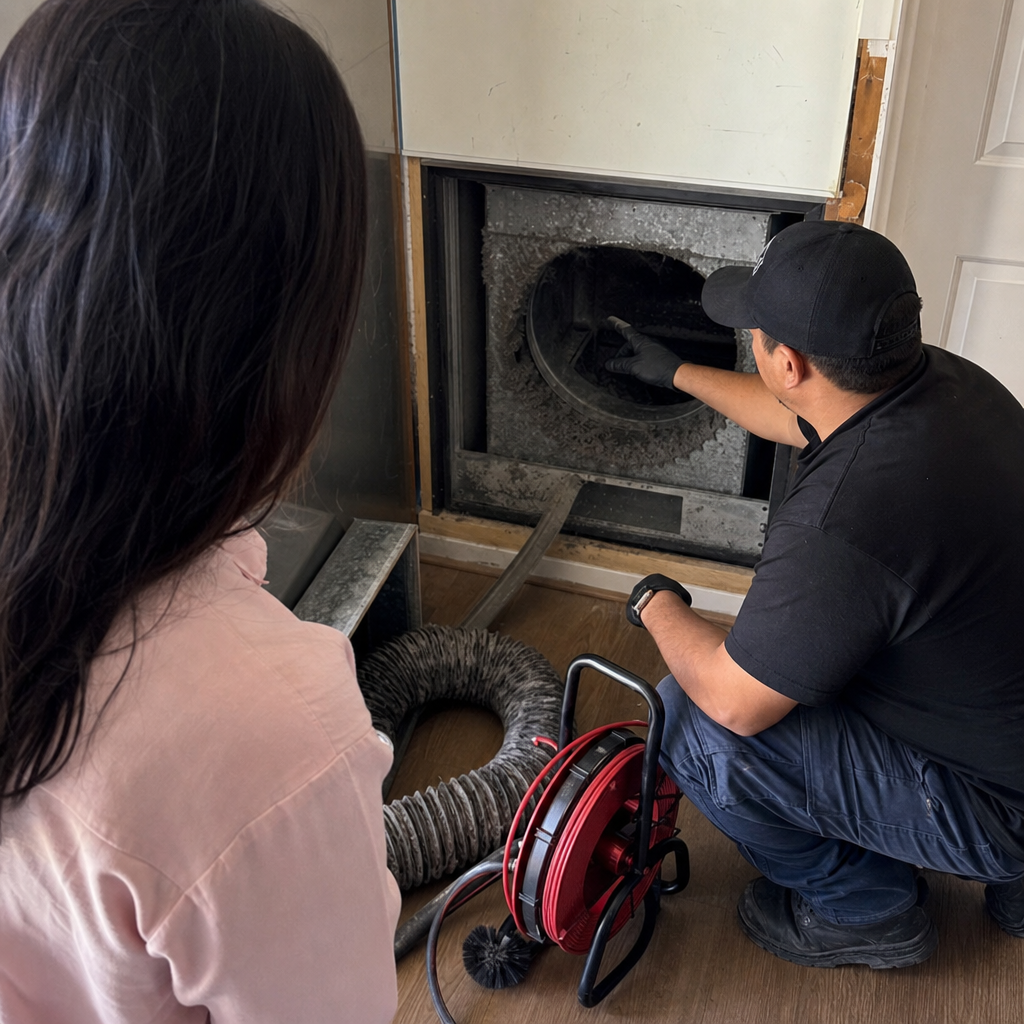
When we run a job, we use Rotobrush agitation systems alongside Nikro negative-pressure equipment to dislodge and extract debris simultaneously, so it doesn’t redistribute into your living space during the process. For homes with microbial concerns — mold spores, bacterial growth in humid return-air plenums — we bring in Abatement Technologies solutions and follow up with a sanitizing treatment that addresses what mechanical cleaning alone can’t reach.
This is also why we keep Air Duct Cleaning in Los Angeles as a single-crew operation: Matthew is on the job, not dispatching a subcontractor to your house. When the same person does the assessment and runs the equipment, the recommendations don’t get inflated between departments.
If you want to understand what full professional duct cleaning covers from a technical standpoint, our Air Duct Cleaning service page walks through the process in detail.
Clean ducts don’t announce themselves — you just breathe better and stop wondering why your filter fills up so fast.
Signs You Shouldn’t Wait for Your Scheduled Interval
Timing guidelines are useful baselines, but some conditions in Los Angeles warrant moving the schedule up regardless of when you last had service:
- Visible dust or gray-brown residue on supply register faces after closing windows during a fire event
- A filter that’s loading up noticeably faster than it used to — often a sign of debris migrating past the filter into the duct system
- A musty or smoky smell from vents when the system first kicks on
- Worsening allergy or asthma symptoms at home that don’t correlate with outdoor pollen counts
- Uneven airflow between rooms, which can indicate debris accumulation or early duct damage in a section of the system
Any of these, in a Los Angeles home with the basin’s air quality profile, is a reason to have the system looked at sooner rather than later.
Frequently Asked Questions
In Los Angeles, most homes benefit from professional duct cleaning every 2 to 4 years — shorter than the national 3–5 year guideline — because the basin’s wildfire smoke, freeway PM2.5, and Santa Ana dust events load ductwork faster than in most other cities. Older homes near the 110 or 10 corridors, or any property that came through a significant fire season, should lean toward the 2-year end of that range. Call (866) 359-7544 for a free assessment if you’re not sure where your home falls.
Skipping duct cleaning for many years allows accumulated dust, debris, pet dander, and in some Los Angeles homes, wildfire ash and Mojave dust, to build up into a thick layer that restricts airflow, overworks your HVAC blower motor, and continuously circulates through your living space each time the system runs. In older pre-1978 properties in South LA or Koreatown, undisturbed duct debris can also contain asbestos-containing materials from original insulation wrap — a hazmat concern that gets more complicated the longer it sits.
Consumer vacuum attachments and brush kits can clear the first few feet of duct from a register opening, but they don’t reach or dislodge debris in main trunk lines, plenums, or return-air boxes — where the bulk of contamination accumulates. For Los Angeles homes dealing with wildfire ash or heavy particulate loading, DIY attempts without negative-air containment often push debris deeper into the system or redistribute it into the living area. Professional equipment like Rotobrush and Nikro systems is specifically designed to agitate and extract simultaneously, which is a different mechanical process than what a shop vac achieves.
A thorough professional cleaning removes the accumulated particulate that your system keeps recirculating — so yes, most households notice a measurable difference, especially those with allergy or asthma sensitivities. The effect is more pronounced in Los Angeles than in many cities because the baseline contamination load here is higher: a closed home near a freeway corridor in the 90089 or 90095 zip codes accumulates particulate year-round, not just seasonally. Adding a sanitizing treatment after mechanical cleaning addresses microbial residue that physical removal alone doesn’t eliminate.
Ready to Know Where Your Home Actually Stands?
If you’ve been running your system on an old cleaning schedule — or you’re not sure when it was last done — Elite Air Duct Cleaning Service Los Angeles offers a straightforward, no-pressure assessment. Matthew Gonzalez and our crew work across Los Angeles with professional-grade Rotobrush and Nikro equipment, and we’ll tell you honestly whether your system needs cleaning now or whether you can wait. Call (866) 359-7544 for a free estimate.
Written by Matthew Gonzalez, Owner & Lead Technician at Elite Air Duct Cleaning Service Los Angeles, serving Los Angeles, CA.